
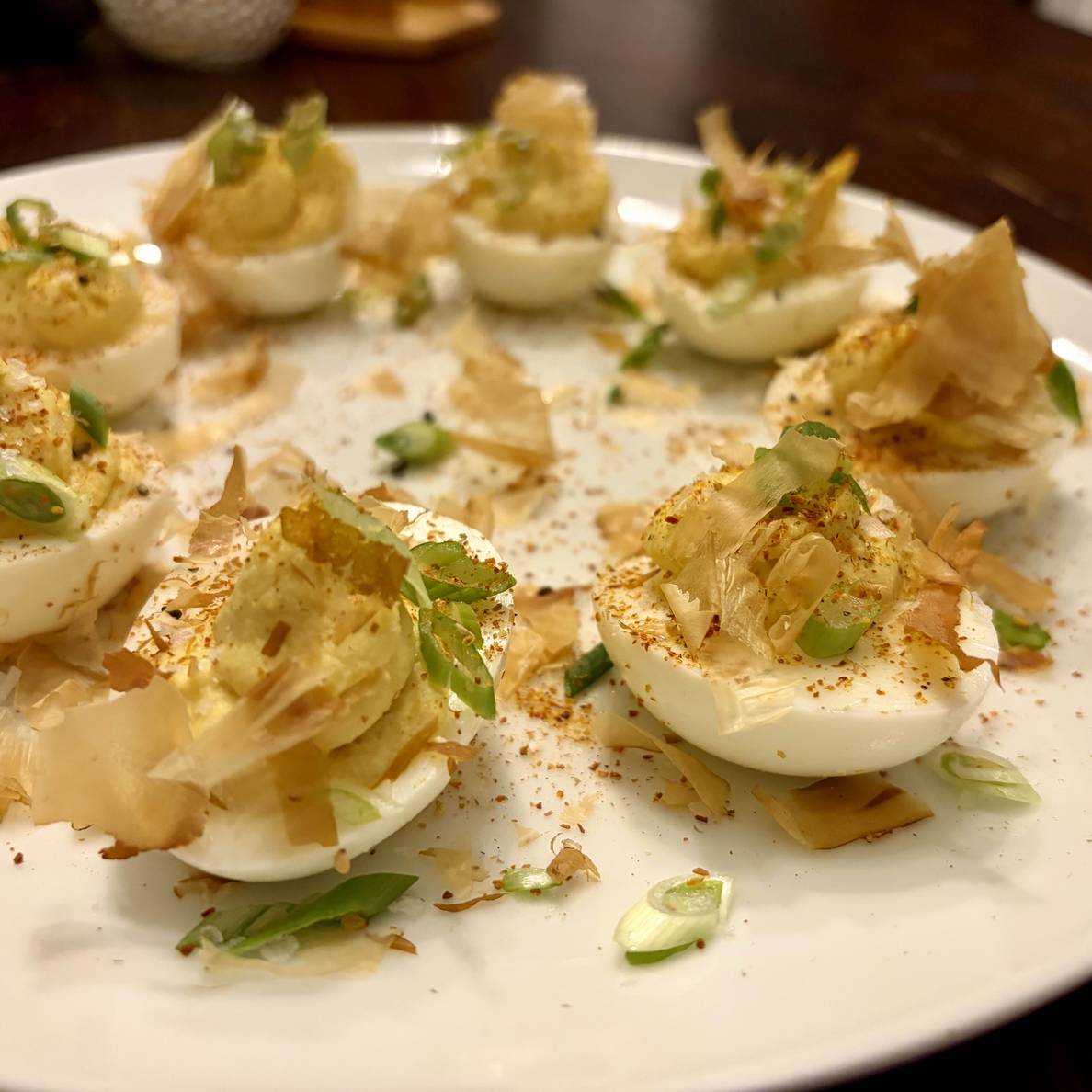
Last week I made the Katsuobushi Deviled Eggs recipe from J. Kenji Lopez-Alt’s The Wok cookbook.
The recipe starts with the same Perfectly Peelable Steam Boiled Eggs as the Ajitsuke Tamago, but hard boiled this time.
Interestingly, while I didn’t have any egg white leaking last time, I did this time, and one of the eggs burst out of its shell while boiling. Otherwise, I had similar results.
Each egg is cut in half and the yolk removed and put in a food processor. Kenji calls for 6 eggs and using the eight best-looking egg white halves. I was down two halves from the burst egg, and I had several oddly-position yolk holes, some very close to the bottom. It turned out not to matter too much.
The chosen egg white halves get washed of any remaining yolk.
The yolks are processed with rice vinegar, powdered karashi, mayonnaise, and Hondashi. I checked H-Mart and First Oriental Market for karashi. From what I could tell, H-Mart had some, but in paste form. Both had “S&B Oriental Hot Mustard,” which is what I ended up using. I don’t know if this is karashi, but Kenji notes that “dried Chinese or English hot mustard” can be used as a substitute.
The yolk mixture is seasoned with salt and then piped into the egg white halves. I used a ziploc bag with a corner cut off. Kenji directs to overstuff the egg white halves, which I felt I did, but I still had a bit left over.
On top of the stuffed egg white halves go sliced scallions, shichimi togarashi, katsuobushi, and course sea salt.
I’ve never made deviled eggs before, so I don’t really know how this recipe differs other than the distinctly east Asian ingredients. I thought the end result was tasty. Megan didn’t care for the fishiness of it, which is its defining characteristic.
I am cooking my way through J. Kenji Lopez-Alt’s The Wok cookbook. Read more about it.